Research Note #2: 20 Years of Civic Attitudes in Haiti
Analysis of 8 waves of the LAPOP AmericasBarometer survey (2006-2023) · Published July 3, 2026
In Note #1 we analyzed the 2021 and 2023 data. Now we go back 20 years: eight waves of LAPOP's representative surveys (2006, 2008, 2010, 2012, 2014, 2016-17, 2021, 2023 — more than 15,000 respondents in total). The question: when did Haitians lose confidence, and in what exactly?
Finding 1: The Collapse Began After 2012
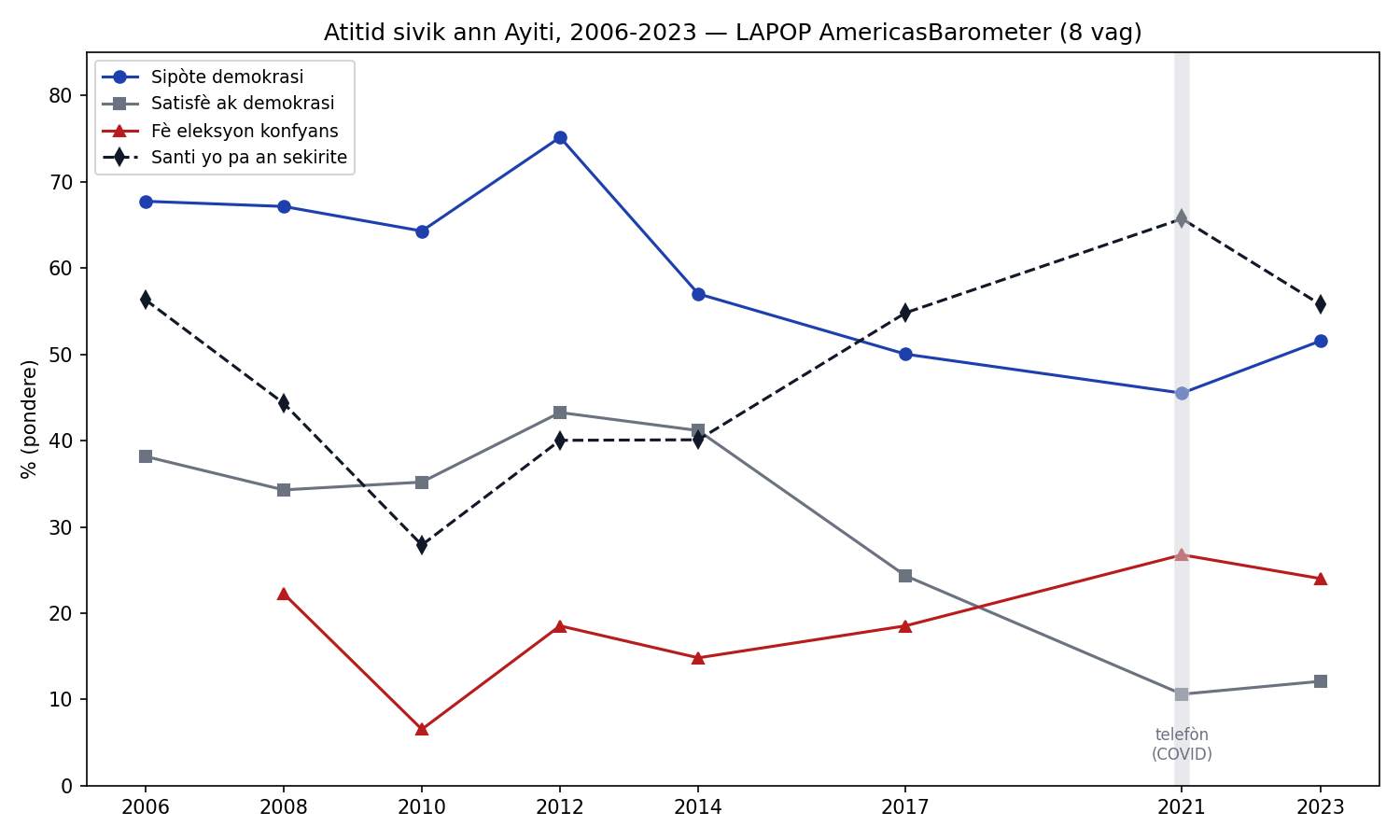
Support for democracy climbed to 75% in 2012 — then fell without pause, reaching 46-52% today. Satisfaction with how democracy works was 38-43% between 2006 and 2014; it dropped to 24% in 2016-17 and collapsed to 11-12% since 2021. So the confidence crisis did not begin with the 2021 assassination — the erosion started in the mid-2010s, in the same period as the disputed 2015-2016 elections and the PetroCaribe scandal.
Finding 2: Trust in Elections Was Always Weak
In 15 years of data (2008-2023), trust in elections never exceeded 27%. The minimum was 7% — in 2010, in a survey fielded weeks after the earthquake and after the 2009 Senate elections that excluded Fanmi Lavalas. This means distrust of elections is not a new phenomenon: it is a chronic condition that the next elections will have to overcome.
Finding 3: Intention to Vote Is Falling Steadily
In the four waves where LAPOP asked the question (2012, 2014, 2016-17, 2023), the share saying they would vote for a candidate fell: 61% → 59% → 49% → 41%. A 20-point drop in 11 years. This may be the most important number for participation campaigns: the problem is not only organizing elections — it is convincing a people who no longer quite believe voting matters.
Finding 4: The Youth Pattern, in 20-Year Context
| Wave | 2008 | 2010 | 2012 | 2014 | 2016-17 | 2021 | 2023 |
|---|---|---|---|---|---|---|---|
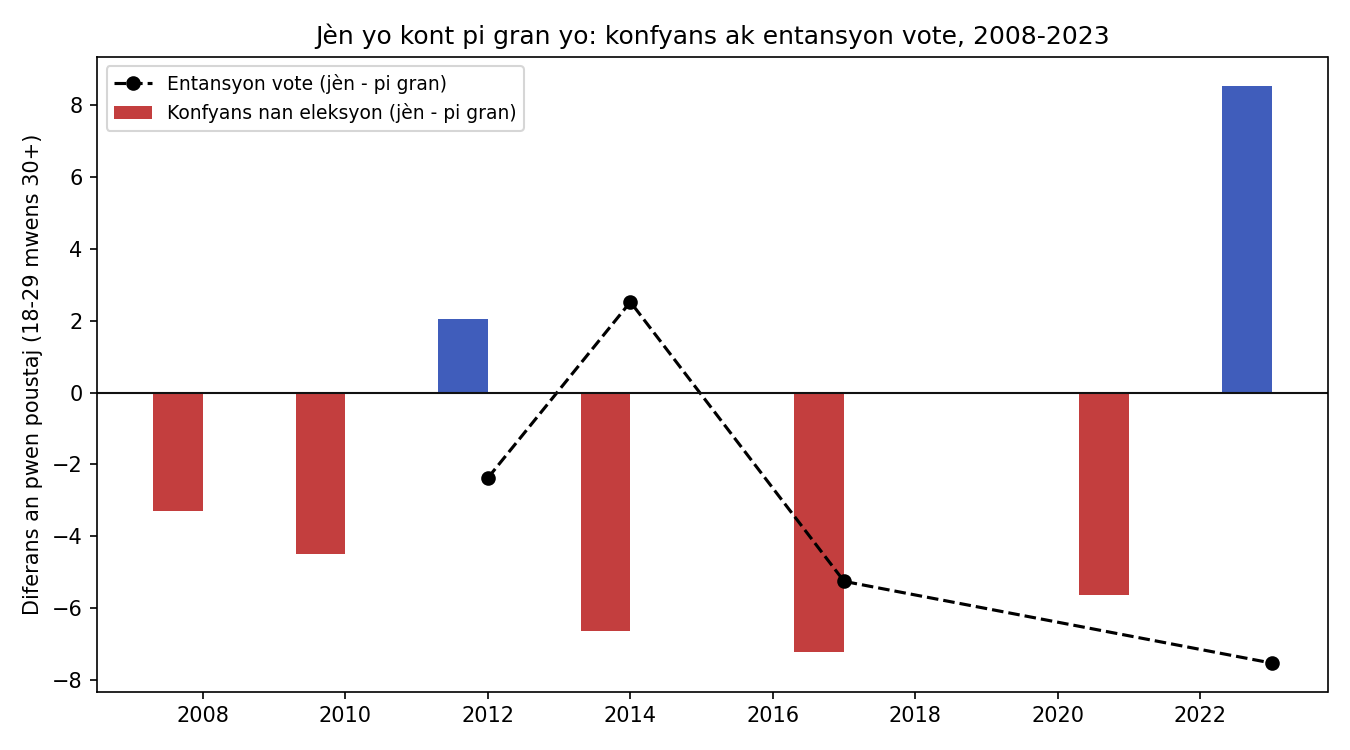
| Trust-in-elections gap (youth − older, points) | −3.3 | −4.5 | +2.1 | −6.7 | −7.2 | −5.6 | +8.6 |
| Vote-intention gap (youth − older, points) | — | — | −2.4 | +2.5 | −5.3 | — | −7.5 |
The historical context changes the interpretation from Note #1. First: in five of seven waves, youth trusted elections LESS than their elders — the +8.6-point youth advantage in 2023 is the largest gap in the whole series, in either direction. It may be real (a generation that has never experienced a failed election) or statistical noise (the question was asked of only half the sample). Second — and this is more solid: the youth participation gap is a worsening trend: +2.5 in 2014, −5.3 in 2016-17, −7.5 in 2023. Whatever is happening with trust, young Haitians are drifting further from the ballot box with every election. That is what our pre-registered study will test.
Methods and Limitations
Data: 8 waves of the LAPOP AmericasBarometer Haiti, more than 15,000 respondents in total. All 2010-2023 estimates are weighted with the official weights; the public 2006 and 2008 files carry no weight variable (samples were designed to be self-representing) — we state this plainly. The 2021 wave was by telephone (COVID); all others face-to-face — 2021 comparisons should be treated with caution. The trust-in-elections question changed its code between 2010 and 2012 (b47 → b47a) but kept the same wording. Our analysis code is available on request: research@ayitisitwayen.org.